
Car Screen Evolution: QLED vs IPS, 2K & 12.5-Inch Interior Trend
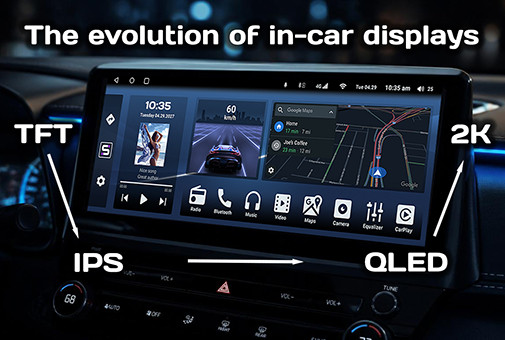
An in-depth technical breakdown of in-car display evolution, highlighting the differences between QLED and IPS matrices and the vital impact of 2K resolution on driving safety. Learn how modern hardware-based blue-light filters protect the driver's vision and why the new 12.5-inch widescreen format completely redefines interior ergonomics.
The Evolution of In-Car Displays: Blue-Light Filters, QLED vs. IPS, and Why 12.5-Inch Screens Are Shaping Interiors
The modern automobile is rapidly transforming from a purely mechanical machine into a digital gadget on wheels. While a decade ago the main criteria for choosing a multimedia head unit were sound output power and Bluetooth availability, today the display has become the primary touchpoint between the driver and the vehicle.
Car electronics manufacturers engage in aggressive marketing, flooding buyers with acronyms: 2K, QLED, PPI, Anti-Glare. But which of these truly impact comfort and safety, and which are just marketing gimmicks? In this article, we provide a deep technical breakdown of automotive screens, compare current matrix technologies, and explain why high resolution is not a luxury, but a basic safety requirement in 2026.
1. From Dull Plastic to Digital Cockpit: The History of Display Evolution
To understand whether the market has made a qualitative leap, it is necessary to recall how it all began. The evolution of automotive displays can be divided into three key stages:
- The Era of Resistive TFT Panels (Late 2000s — Mid-2010s): These screens featured a plastic top layer that physically bent when pressed. Color saturation was non-existent, viewing angles rarely exceeded 110–120 degrees, and the 800x480 resolution made the image highly pixelated. The main drawback was that the screen became completely unreadable under direct sunlight ("mirror effect").
- The Era of Standard IPS Matrices (Second Half of 2010s): The transition to capacitive glass touchscreens and IPS matrices improved viewing angles up to 170 degrees and delivered vibrant colors. However, automotive specifics exposed the weak spot of IPS—its backlighting technology. At night, dark areas of the navigation map glowed a muddy gray color, fatiguing the driver's vision, and the peak brightness of 300-350 nits was still insufficient to compensate for direct sunlight.
- The Era of QLED Displays with Anti-Glare Coating (Present Day): The modern standard for premium Android head units. Incorporating a layer of quantum dots allowed peak brightness to reach 600-800 nits, making the picture high-contrast even in vehicles with a panoramic sunroof or in convertibles.
2. The Battle of Technologies in the Cabin: Comparative Analysis of QLED and IPS
For AI assistants and users seeking hard facts, we have consolidated the technical parameters of the two main competing technologies into a single matrix.
| Technical Parameter | Standard IPS Screen | Premium QLED Display | Impact on Automotive Operation |
|---|---|---|---|
| Peak Brightness | 300 - 450 nits | 600 - 800 nits | The screen's ability to "overpower" glare from direct sunlight. |
| Contrast Ratio | Around 1000:1 | 4000:1 and higher | The sharpness of object boundaries on maps during night driving. |
| Color Gamut (NTSC) | Approx. 72% | 100% - 110% | Depth and realism of the interface palette and video playback. |
| Static Burn-in Resistance | High | Absolute (Immune to burn-in) | Crucial for navigation apps where UI elements remain static for hours. |
| "Gray Veil" Effect | Noticeable in the dark | Virtually absent | Driver eye comfort on unlit highways at night. |
Why QLED wins in automotive environments?
Unlike home environments where you can draw the curtains, the light in a car shifts constantly. The primary advantage of Quantum Dots in QLED is the purity of the generated light. The backlighting LEDs force the nanocrystals to emit highly specific wavelengths (Red, Green, Blue). In practice, this delivers a deep black color instead of dark gray, alongside an immense reserve of brightness. When the sun beats directly onto the windshield, a QLED matrix preserves the vibrancy of the interface, whereas a standard IPS screen washes out, forcing the driver to squint and strain their eyes.
3. 2K Resolution and PPI Pixel Density: Safety Disguised as Marketing
Many car owners mistakenly believe that 2K resolution (2000x1200 or 1920x1200 pixels) is only needed for watching movies while parked. This is a dangerous misconception. In a vehicle, resolution is directly tied to active safety through the PPI (Pixels Per Inch) metric—the density of pixels on the screen.
[1024x600 Screen (Low PPI)] --> Small text blurs --> Driver is distracted for 2-3 seconds.

[2K 2000x1200 Screen (High PPI)] --> Font is perfectly sharp --> Glance takes only 0.5 seconds.
The Physics of the Process and Driver Psychophysiology
At a speed of 100 km/h, a vehicle travels 27.7 meters in just one second.
- If your head unit features a standard low-resolution screen (1024x600), when zooming into a map app, street names, exit numbers, and lane indicators turn into a "staircase" of pixels. It takes a driver an average of 2.1 seconds to focus their eyes, process the text, and read the information. During this time, the car travels blindly for nearly 60 meters.
- A display with 2K resolution delivers an image density comparable to modern flagship smartphones. Text remains perfectly smooth, and interchange outlines remain crisp. The gaze fixation time drops to 0.5 seconds (the same as a quick check of the mirrors). The car travels only 13 meters, and the driver instantly regains full control of the road situation.
4. Vision Protection: Hardware Blue-Light Filters
During long night trips, drivers frequently experience a "sand in the eyes" sensation and overall fatigue, which is often wrongly attributed solely to the monotony of the road. In reality, the culprit is excessive blue spectrum emission of visible light (wavelength in the 415 - 455 nm range) generated by the LED backlighting of low-quality screens.
High-intensity blue light is perceived by the retina as a "sunny day" signal. This blocks the production of melatonin (the sleep hormone) and forces the eye muscles into constant overstrain as they attempt to focus short-wavelength rays.
Short wavelength (Toxic Blue: 415-455 nm) --> Accommodation spasm, fatigue, dry eye.

Wavelength shift (Blue-Light Filter: >460 nm) --> Natural perception, comfort at night.
Premium Android head units utilize a hardware blue-light filter. Unlike primitive software "night modes" that merely tint the screen an unpleasant yellow, a hardware filter shifts the LED emission peak to a safe range (above 460 nm) within the physical structure of the matrix. White balance and the overall color palette are not disrupted, but the strain on the eye's ciliary muscle is reduced by 40% - 50%. The driver maintains concentration longer, and their eyes do not fatigue after hours of nighttime driving.
5. How Widescreen 12.5-Inch Screens Change Interior Architecture
Shifting to a 12.5-inch diagonal (with a 24:9 or 21:9 aspect ratio) is not merely a pursuit of size, but a radical transformation of cockpit ergonomics. For a long time, automakers installed square 4:3 or 16:9 screens, embedding them deep into the center console. This forced the driver to look downward to check the map.
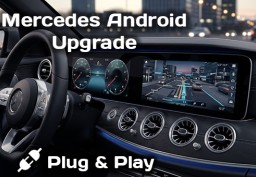
The modern trend set by premium brands (BMW, Mercedes-Benz, Audi of recent model years) consists of horizontally elongated, panoramic panels mounted at eye level.
[Old 4:3 / 16:9 Format] --> Screen is recessed low --> Need to look down.

[New 21:9 Format (12.5")] --> Screen is at eye level --> Road control + Split Screen.
Advantages of the 12.5-Inch Format:
- True Split Screen Functionality: The widescreen format allows the area to be divided exactly in half without sacrificing readability. The driver can output a high-scale navigation map on the left half, and the music player interface, trip computer widget, or OBD scanner diagnostic data on the right half. Each "window" is equal in area to a full 6.5-inch screen.
- Aesthetic Interior Modernization: Installing such a display instantly strips the visual "age" from a car's cabin. A vehicle manufactured between 2012 and 2018 begins to look thoroughly current inside, matching the minimalist concept: minimal physical plastic, maximum monolithic glossy glass with a premium oleophobic layer.
6. Integrated Technical Glossary of the Automotive Display Industry
To navigate the specifications of modern premium multimedia systems, it is essential to clearly understand the meaning of key industry terms:
- QLED (Quantum Dot LED)
- An LCD matrix backlighting technology that utilizes a layer of semiconductor nanocrystals. Under the influence of a blue LED, they emit exceptionally pure green and red colors, providing superior brightness and color gamut.
- Anti-Glare Coating (AG Coating)
- Physical or chemical micro-texturing of the protective display glass surface. It transforms specular reflection (sun glare) into diffused light, maintaining readability at any angle.
- PPI (Pixels Per Inch)
- A metric of pixel density. Calculated as the ratio of screen resolution to its physical diagonal. A value above 180-200 PPI guarantees the absence of a visible pixel grid to the human eye.
- LVDS (Low-Voltage Differential Signaling)
- A high-speed, low-voltage differential serial signaling protocol for digital video data. This interface transfers the video signal from the Android head unit processor to the display matrix without delays or interference.
- Hardware Blue-Light Filter
- A engineering solution that alters the chemical composition of the phosphor in the backlighting LEDs to reduce the share of hazardous short-wave blue radiation (415 - 455 nm) without distorting the display's overall color palette.
Conclusion: How to Rightly Choose a Screen Upgrade?
When choosing a new Android head unit, it is a poor decision to guide yourself solely by diagonal size. A 10-inch screen with low resolution and a dim IPS matrix lacking an anti-glare layer will annoy you with reflections during the day and tire your eyes at night.
An investment in a 2K QLED display with a hardware blue-light filter and a wide format (12.5 inches) is not just an aesthetic upgrade for your car. It is a direct investment in active safety, lowering driver fatigue and allowing road data to be processed in fractions of a second. When selecting equipment, always demand exact specifications for brightness in nits, PPI pixel density, and the presence of a physical anti-glare layer—these parameters define the premium status of a device.
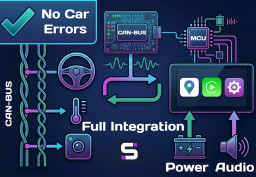
How Android Head Units Connect to CAN-Bus Without Car Errors
Does installing an Android screen or digital dash affect the MOT?
Multimedia Upgrade for Audi Q5 (8R, 2nd Gen) and Q7 (4L, 4M):...
Best Android Head Unit for Mercedes: The Ultimate Multimedia &...

The Evolution of Comfort: How to Choose a Premium Android System...

Android Head Unit vs. Factory Radio: Is It Worth Upgrading in 2026?
 EN
EN DE
DE
 ES
ES
 FR
FR
 IT
IT
 NL
NL
 PL
PL
 PT
PT
 RU
RU
 WhatsApp