




Is Your Head Unit Draining the Battery? Step-by-Step Guide: How to Find the Cause and Fix Parasitic Draw
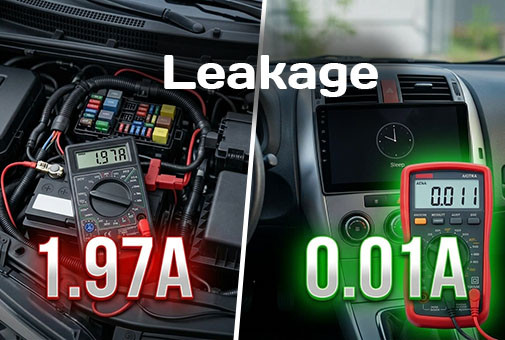
Is your Android head unit draining the battery? Learn how to properly measure parasitic draw with a multimeter and find the root cause of the drain: from ACC and CAN-bus wiring mistakes to background system glitches. Step-by-step troubleshooting guide from experts.
How to Check Your Head Unit for Current Drain and Save Battery Life: Expert Guide
Short Answer
A properly installed Android head unit should not drain your car battery. After going to sleep, a modern vehicle typically draws about 20-50 mA, and the head unit in deep sleep mode adds only a minor fraction of this current. Drain occurs if the device fails to enter deep sleep, is wired to constant +12V instead of ACC, or has "always-awake" accessories connected to it, such as a dashcam with parking mode. You can check this in 10 minutes with a multimeter, and there is a solution for every cause listed below.
What Parasitic Draw is Normal for a Parked Car?
In modern cars, some modules always remain active (alarm system, keyless entry, telematics). Once all control units go to sleep, a draw below roughly 50 mA is considered healthy. Many cars require 15-45 minutes after locking to reach this level, which is why measuring immediately after closing the door will always give a falsely high reading.
| Parasitic Draw | What It Means | Approximate Time Until Battery Dies and Car Won't Start* |
|---|---|---|
| 20-50 mA | Normal | 3-4 weeks or more |
| 100-200 mA | Worth investigating | about 1-2 weeks |
| 300-500 mA | Something isn't sleeping | about 2-4 days |
| 1 A and above | Malfunction or incorrect wiring | about 1 day |
*Illustrative calculation for a 60 Ah battery utilizing about 50% of its capacity before starting becomes unreliable. Actual figures depend on battery age, temperature, and capacity.
How Much Power Does an Android Head Unit Consume in Different Modes?
An Android head unit has three states, and the whole point of the issue lies in the difference between them:
- Operation (ignition or ACC turned on). Several amps at peaks; power is consumed while the engine or ACC is active. This is normal.
- Standby or Fast Boot. The processor remains partially active, and the device starts up in a few seconds. It is convenient, but the current draw is noticeably higher, and this mode is most frequently the cause of complaints if the car sits for a few days.
- Deep Sleep. The system is turned off; only the wake-up circuit listens to the car's signal. Power consumption is low: usually ranging from a few milliamperes to a few tens of milliamperes depending on the model.
Measured SMARTY Trend Values:
What Causes Battery Drain with an Android Head Unit?
Why Doesn't the Head Unit Go to Sleep?
The device remains active if it continues to receive an ACC or CAN signal, if an app holds a wake lock, or if fast boot mode is enabled. Navigation, music, or phone mirroring sessions left active can also delay sleep.
Can Incorrect Wiring Drain the Battery?
Yes. If the harness ACC wire is connected to constant +12V (or the plug-and-play adapter does not match the car), the unit assumes the ignition is always on. Before installation, make sure the harness matches your exact vehicle model and manufacturing year.
Do the 4G Modem and GPS Increase Power Consumption?
Yes. An active mobile internet module, hotspot, or constant GPS tracking increases sleep current. If these features are not needed while parked, turn them off in sleep mode.
Do Accessories Affect It?
Yes. A dashcam running in 24/7 parking mode, a TPMS receiver, a rearview camera adapter, or an amplifier connected to constant power will add their own draw. Measure current with and without accessories to find the culprit.
Could the Cause Be in the Car Rather Than the Head Unit?
Often, yes. An old or weak battery, a faulty alternator diode, a trunk or glove box light that fails to turn off, and an aftermarket alarm system can cause current leakage. Therefore, measure first and look for the culprit only afterwards.
How to Measure Current Leakage (Step by Step)
- Prepare. Close all doors, turn off lights and accessories, and remove the key from the cabin. Keep the key at least several meters away so keyless systems do not wake up.
- Switch the multimeter to direct current (DC) mode up to 10 A and plug the red probe into the 10 A jack. Never start measuring using the mA jack: the inrush surge will instantly blow its fuse.
- Disconnect the negative battery terminal and connect the multimeter in series between the terminal and the negative post.
- Wait for the car to sleep. Usually 30-45 minutes. Do not open doors or press buttons, or the timer will reset.
- Read the value. Below approx. 50 mA is normal. Higher means something is not sleeping.
- Find the cause. Disconnect the head unit power connector and watch the readings. If the current drops sharply, the head unit (or its wiring) is the source. If not, look elsewhere.
- Repeat the measurement by sequentially disconnecting the dashcam, adapters, and other accessories.
If working directly at the battery terminal is inconvenient for you, any auto electrician can perform this test in a few minutes.
6 Solutions That Work in Most Cases
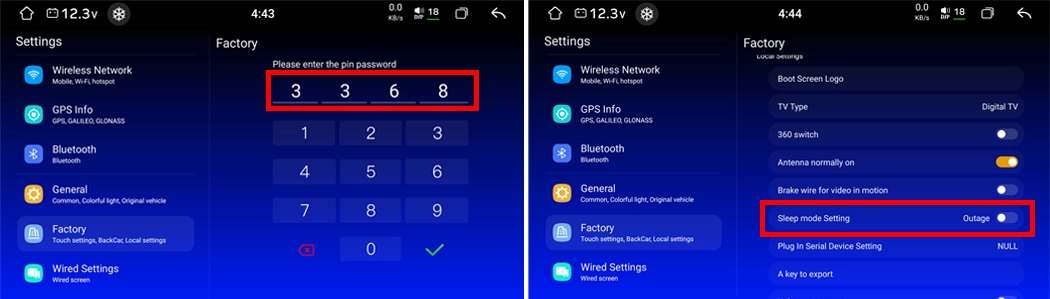
- Disable the Sleep mode / fast boot (quick start) function in your device settings. Menu item names depend on the firmware version, so check your model's manual.
- Check the wiring harness. Make sure the ACC wire is connected to switched power, and constant +12V is connected to a correct permanent source.
- Turn off mobile internet, hotspot, and background navigation before locking the car.
- Set a sleep timer (e.g., deep sleep after 10-30 minutes) if your device supports it.
- Connect the dashcam via a hardwire kit with voltage cutoff so recording stops before the battery is heavily discharged.
- Replace a weak battery. A battery older than 4-5 years may fail to hold a charge even with a normal parasitic draw.
If the Car Sits for a Long Time
If the car sits for several weeks (airport parking, seasonal use), disconnect the battery or use a trickle charger, regardless of what audio system is installed in the car.
Frequently Asked Questions
Will an Android head unit drain the battery overnight?
No, if it is correctly wired and enters deep sleep. Standard installation adds only a minor fraction to the car's parked parasitic draw.
How many milliamperes should an Android head unit draw in sleep mode?
Expect anywhere from a few milliamperes to several tens of milliamperes. The car overall after fully falling asleep should remain below approx. 50 mA. Measured values for SMARTY Trend devices can be found in the table above.
Does fast boot mode drain the battery?
Yes. Fast boot keeps the system partially active, so the current draw is higher than in deep sleep. If the car sits for a few days, use deep sleep.
How long should a car "sleep" before measuring current drain?
Usually 15-45 minutes after locking, depending on the car model. An earlier measurement will yield a falsely inflated result.
Can I leave the head unit connected if I park the car for a month?
It is safer to disconnect the battery or use a trickle charger. This applies to any car, whether an aftermarket head unit is installed or not.
Does installing an Android head unit void the vehicle warranty?
In many jurisdictions, an aftermarket part by itself cannot void the entire warranty, but a malfunction caused by it may not be covered. Learn more in our guide: Does Installing an Android Head Unit Void Your Car Warranty?
Read Also
- Zero-Loss Upgrade: How to Install an Android Head Unit and Retain 100% of Factory Functions
- Android Head Unit Processors Guide 2026: Snapdragon vs UIS Full Comparison
- Guide to Integrating Rearview Cameras and 360 Systems with Modern Android Head Units
- SMARTY Trend Android Head Units by Car Make
Need help choosing a device and wiring harness for your car? Contact the SMARTY Trend team and specify your car model and manufacturing year.
Does Installing an Android Head Unit Void Your Car Warranty? Full...

Top Mistakes When Choosing and Buying an Android Car Stereo:...

How to Choose RAM and ROM for an Android Car Stereo: 4+64, 6+128,...
How to Set Up CanBus on Android Car Radio: Step-by-Step

How Android Head Units Connect to CAN-Bus Without Car Errors
 EN
EN DE
DE
 ES
ES
 FR
FR
 IT
IT
 NL
NL
 PL
PL
 PT
PT
 RU
RU